6 Mistakes People Make When Working with Deaf Students with Autism (And What to Do Instead)
Feb 19, 2026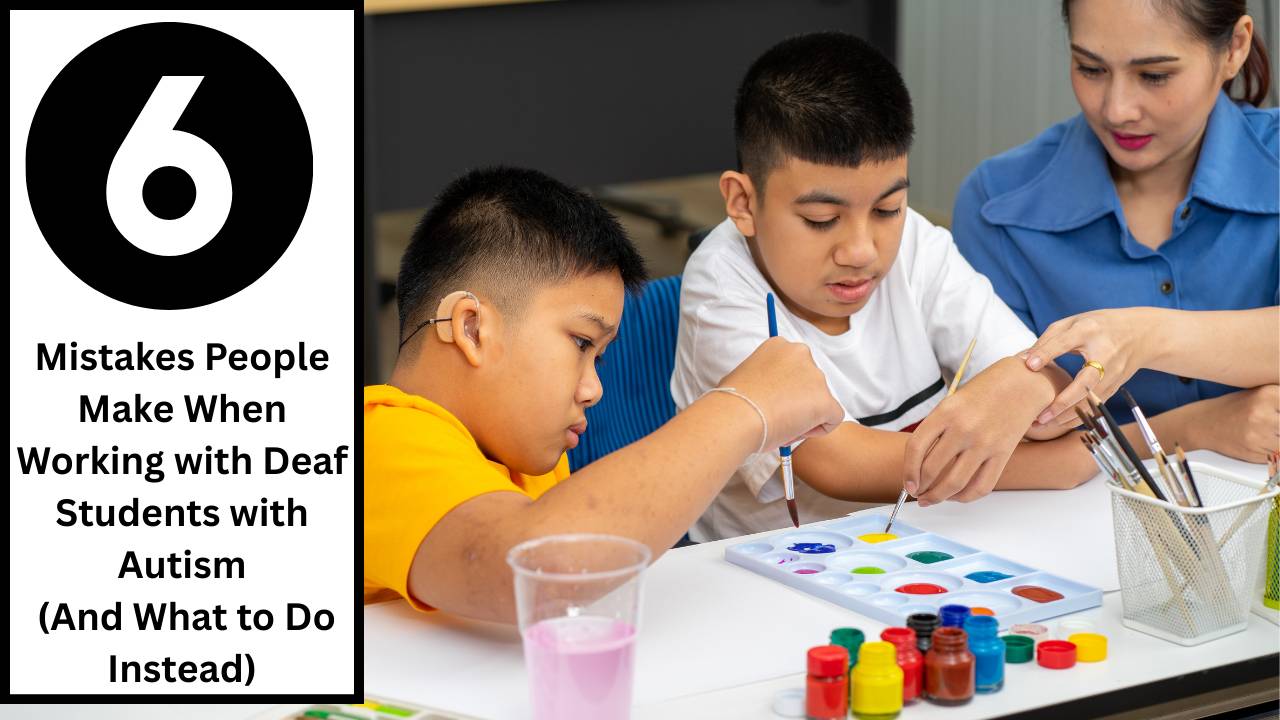
As caseloads shift across the country, more teachers of the deaf are supporting students who are deaf with additional disabilities — and autism is one of the most common.
Students who are deaf with autism are complex. Most teachers of the deaf were never formally trained to navigate both deafness and autism together.
After Kelly Anderson's recent masterclass, Working with Deaf Students with Autism, I pulled together six common mistakes that commonly happen, along with practical corrections that can make an immediate difference. I shared my biggest "ah-ha" moments from this fantastic training on my YouTube channel. You can watch it here.
Mistake #1: Diagnosing Autism Before Ruling Out Other Causes
One of the most serious missteps is assuming autism without carefully ruling out other explanations.
Several conditions can look like autism in deaf students:
-
Language deprivation
-
Vision issues
-
CHARGE syndrome
-
Unidentified hearing variables
Language deprivation in particular can mimic autistic characteristics. When expressive and receptive language begins to develop, many “autistic-like” behaviors may reduce or even disappear.
What to do instead:
Ensure evaluations are collaborative. A school psychologist or autism specialist should never assess a deaf student in isolation without consultation from a TOD. Rule out sensory and language access barriers first before labeling a student as having autism.
Mistake #2: Identifying the Primary Disability Instead of the Primary Need
Is the primary barrier access to communication?
Or is it autism-related regulation and engagement?
In a deaf school setting, visual access may already be built into the environment. In that case, autism may be the bigger barrier to participation. In a mainstream setting without adequate access supports, hearing status may be the primary obstacle
What to do instead:
Ask: What is preventing access to the curriculum right now?
Services should target the barrier — not just the label.
Mistake #3: Forcing Visual Attention
Waving in a student’s face.
Turning their chin.
Overstepping personal boundaries to “make” eye contact.
This doesn’t build connection. It's intrusive.
What to do instead:
Use an object to guide attention:
-
Present the object.
-
Allow the student to visually lock in.
-
Gradually move the object toward your face.
-
Sign (or speak) within the student’s visual field.
This respects boundaries while supporting joint attention.
Mistake #4: Skipping Visual Schedules Because “They Know the Routine”
Even students who know the routine benefit from visual structure.
Visual schedules reduce anxiety. Many neurotypical adults rely on calendars and timers to reduce stress — our students need that predictability even more.
And here’s the key: Sometimes listing activities isn’t enough.
Instead of listing one subject at a time, such as “Math”
Try identifying what needs to be done inside each subject area, especially if a student has anxiety with a certain task or subject. For example, in the area of math, try listing “Complete 3 math problems”
In addition, related to the schedule, timers may also need flexibility. A rigid 30-minute countdown can cause distress if the schedule changes unexpectedly.
What to do instead:
-
Use manipulable timers when possible.
-
Keep visuals simple — they do not need to be laminated masterpieces.
Pro Tip: Try using a mini printer which prints photos instantly.
Mistake #5: Correcting Behavior Instead of Teaching Replacement Behavior
“No.”
“Stop.”
“Don’t.”
These responses tell students what not to do but not what to do instead.
Effective behavior teaching tools include:
Social Stories
Social Stories are narratives explaining expected behavior and outcomes.
Power Cards
A Power Card uses a beloved character or role model to model the desired behavior. You can use a picture of the character/person and create a narrative of how that person models the desired behavior.
Comic Strip Conversations
One of my favorite hacks presented by Kelly Anderson in her training was the comic strip conversation. It takes no prep and can be done in the moment - then reused to reinforce the desired behavior. You can do this by following these steps:
Draw:
-
The current behavior
-
Others’ feelings
-
The negative outcome
Then redraw:
-
The desired behavior
-
Others’ feelings
-
The improved outcome
Even stick figures work. Words are optional. It’s visual thinking made concrete.
Mistake #6: Believing You Must Choose Between PECS and ASL
It’s not either/or.
While the PECS system was not originally designed for signing environments, deaf students with autism can benefit from both.
PECS makes communication tangible:
-
I have a message.
-
I must give you my message.
-
You receive my message.
That bridge can be especially powerful during moments of dysregulation.
Signing can also be modified to increase processing time. Holding a sign slightly longer allows the message to “stay visible,” instead of disappearing like spoken words.
Use both when appropriate.
The Bigger Picture
Working with students who are deaf with autism requires peeling back layers:
-
Access
-
Language
-
Sensory regulation
-
Anxiety
-
Communication systems
-
Behavior supports
It rarely resolves overnight. Sometimes it takes years to refine an approach. But here’s the encouraging truth:
There are practical strategies that work. It's valuable to collaborate with others as often as we can, such ashen we collaborate autism specialists, vision specialists, and families, then we expand our own expertise in how to work with thee complex students.
Want to Go Deeper?
If this topic is of interest to you, you'll want to check out the master class Kelly offered through The Online Itinerant. In addition, there are other trainings available inside the Professional Academy that address:
-
Autism screening for deaf students
-
Functions of behavior
-
Sensory regulation
-
Language deprivation
-
Enhancing access for deaf+ students
You are not alone in this shift. Caseloads are changing everywhere. The more equipped we are, the better we can serve these complex, capable learners.
TO GET THESE TRAININGS AND MORE, CHECK OUT THE PROFESSIONAL ACADEMY
CHECK OUR KELLY'S MASTER CLASS HERE
Frequently Asked Questions About Deaf Students with Autism
1. Can language deprivation look like autism in deaf students?
Yes. Language deprivation can look like autism in deaf students because limited early access to language affects social communication, behavior, and emotional regulation. When expressive and receptive language improves, many autism-like behaviors may decrease. That is why language access must be ruled out before diagnosing autism.
2. How do you tell the difference between autism and language deprivation in a deaf child?
The difference lies in the root cause. Language deprivation results from limited access to communication, while autism is a neurodevelopmental condition affecting social interaction across settings. A collaborative evaluation—including a Teacher of the Deaf—is essential to determine whether behaviors stem from access barriers or autism.
3. Should a school psychologist assess a deaf student for autism alone?
No. A deaf student should not be assessed for autism without a Teacher of the Deaf involved. Hearing status, communication modality, and language history significantly affect behavior. Without deaf-specific expertise, autism evaluations may misinterpret access-related challenges as autism.
4. What is the primary disability in a deaf student with autism?
The more important question is not which disability is primary, but which barrier is limiting access. In some settings, communication access is the main challenge. In others, autism-related sensory regulation or engagement is the barrier. Services should address the primary need, not just the label.
5. Why are visual schedules important for deaf students with autism?
Visual schedules reduce anxiety and increase predictability for deaf students with autism. Even when students know the routine, seeing tasks broken into clear, concrete steps supports regulation and independence. Flexible timers and simple visuals can prevent distress when schedules change unexpectedly.
6. What are effective behavior strategies for deaf students with autism?
Effective strategies focus on teaching replacement behaviors rather than correcting unwanted behavior. Social Stories, Power Cards, and Comic Strip Conversations visually model expected behavior, emotions, and outcomes. These tools make social expectations concrete and easier to process for visual learners.
7. Can PECS and sign language be used together?
Yes. PECS and sign language can be used together effectively with deaf students who have autism. PECS makes communication physically tangible through picture exchange, while sign language provides a complete visual language system. Using both can strengthen communication, especially during dysregulation.
8. How do you get a deaf autistic student’s attention respectfully?
To gain attention respectfully, use an object to guide visual focus rather than waving or touching. Present the object, allow the student to visually engage, then move it into your signing space. This supports joint attention without violating personal boundaries.
9. Why is collaboration important when supporting deaf students with autism?
Collaboration is critical because deaf students with autism often have layered needs involving communication, sensory regulation, and anxiety. Teachers of the Deaf, autism specialists, vision professionals, and families must work together to ensure accurate assessment and appropriate intervention planning.
10. What professional development helps teachers working with deaf students with autism?
Teachers benefit from training in autism screening for deaf students, language deprivation, sensory regulation, behavior supports, and access strategies. Specialized professional development equips educators to respond confidently to increasingly complex caseloads.
