Beyond Grades: Why Classroom Observation Is the Missing Key to DHH Success
Jul 24, 2026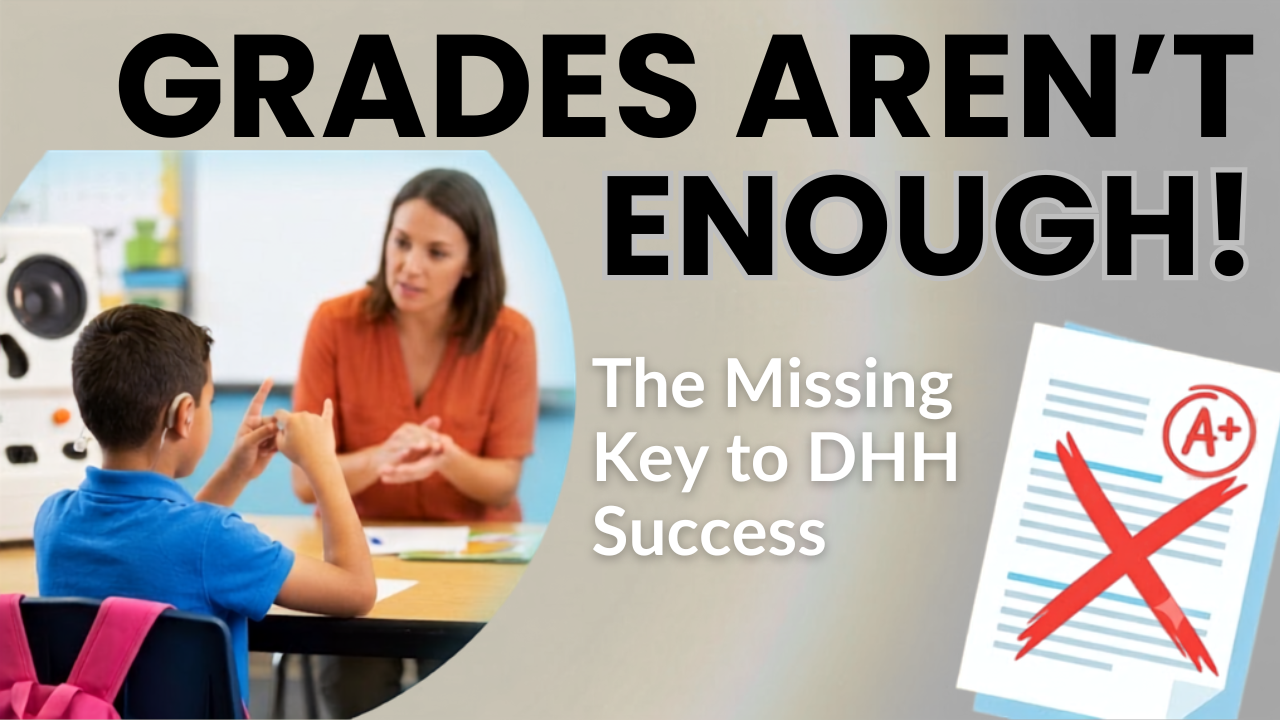
If you have ever sat through an IEP meeting feeling like a pull-out test score failed to capture how a student actually functions during a chaotic school day, you are far from alone.
When a child with hearing loss is tested in a quiet, 1-on-1 speech room, they might repeat isolated words with near-perfect accuracy. On paper, their report card grades might look stellar. But place that same student in a noisy 4th-grade classroom, seated near an open window while a teacher paces across the room without a working microphone, and the reality changes completely.
Over 90% of Deaf and Hard of Hearing (DHH) students in the United States spend more than half of their school day in general education classrooms, with the vast majority using listening and spoken language. Yet, too many IEP teams rely almost exclusively on pull-out evaluations or report cards to determine eligibility and accommodations.
When we rely solely on isolated testing, we miss game-changing data regarding listening fatigue, peer connection, equipment misuse, and mental health. This is why, in my opinion, structured classroom observation is the ultimate assessment tool. This blog post will share with you how you can implement 5 practical observation hacks right away so that you can use it as an assessment tool, too.
The Myth of "Good Grades": What Educational Performance Really Means
The single biggest misconception in special education for DHH students is that passing grades mean a child does not qualify for an IEP (or should be placed on a 504 plan instead).
Administrators and general educators frequently focus on academic output alone. However, official guidance from the U.S. Department of Education confirms that educational performance is far broader than letter grades.
Special education eligibility under the DHH classification requires three elements:
- Documented Hearing Loss: Fluctuating, unilateral, or bilateral; with or without technology.
- Adverse Impact on Educational Performance: Encompassing academic achievement, communication skills, social-emotional functioning, behavior, and participation in the general education setting.
- Need for Specially Designed Instruction (SDI): Targeted, direct instruction in skills including hearing technology troubleshooting, self-advocacy, and auditory processing.
Key Takeaway: A student can maintain B+ grades while simultaneously missing 30% of peer discussions, suffering from exhausting listening fatigue, and experiencing profound social isolation. Output shows what they turned in; observation reveals the cost of that performance.
What Traditional Pull-Out Assessments Miss
Testing a student in a quiet room measures skills in a sterile vacuum. Real-world classroom observation reveals actual, day-to-day access.
1. Classroom Noise & Signal-to-Noise Ratio (SNR)
Students with typical hearing can filter out ambient noise. A student with hearing loss requires a Signal-to-Noise Ratio 10 to 20 dB higher than their hearing peers to understand speech. Background noise severely disrupts incidental learning—the crucial informal learning that happens when catching peer comments, teacher side-notes, and hallway instructions.
2. The Limits of the Functional Listening Evaluation (FLE)
While the FLE is a valuable diagnostic tool (and let there be no mistake - I Iove this assessment as if provides critical information on what a student can auditorily access), it primarily tests whether a student can repeat words back. Repeating words back in controlled conditions is vastly different from answering high-level comprehension questions, taking notes, or synthesizing complex lectures in a lively classroom environment.
3. Remote Microphone System Misuse
Research shows that even when remote microphone systems (FM/DM technology) are provided, they are used properly only about 43% of the time. Observing in class reveals whether the microphone is muted, dangling against a noisy lanyard, resting forgotten on a desk, or rejected by the student due to social stigma.
4. Classroom Community & Mental Health
A strong classroom community gives students a genuine sense of belonging. When a DHH student feels isolated or self-conscious about wearing hearing technology, they disengage. None of these mental health red flags appear on a standardized reading test—they can only be spotted in real time.
5 Practical Hacks for Effective Classroom Observation
Conducting a thorough observation doesn't require sitting in a back corner for six hours with a clipboard. Here is how to make observation manageable, natural, and high-impact.
Hack #1: Be a "Fly in the Soup," Not a "Fly on the Wall"
Sitting silently in the back row with a notepad often makes people uncomfortable—teachers can feel judged, and students may feel "watched."
- The Strategy: Become an active participant in the classroom space. Walk around during group work, squat down, and casually converse with multiple student tables or engage in a classroom activity.
- The Benefit: Interacting with typical peers gives you a direct baseline comparison for your DHH student's engagement and processing pace while eliminating the stigma of a specialist standing over a single child. Tell the classroom teacher in advance: "Just introduce me as a classroom visitor today!"
Hack #2: Observe Across Environments with the 3:1 Service Model
Listening fatigue compounds over the course of the day. A student who appears sharp at 9:00 AM might completely shut down by 1:30 PM.
- Adopt the 3:1 Service Delivery Model: For every three direct pull-out sessions scheduled each month, set aside a dedicated block of time for direct classroom observation, teacher coaching, or pushing into small groups.
- Use this built-in time to arrive 10 minutes early before pulling a student, stay after dropping them off, or co-lead a small reading group.
Hack #3: Observe Through an Specialized "Access Lens"
While a school psychologist observes general behavior, a Specialist in Deaf Education observes access. Look specifically for:
- Seating Placement: Can the student see both the teacher and their peers during discussions?
- Visual/Auditory Distractions: Are they seated near noisy HVAC units, open doors, or visually cluttered displays?
- Peer Comment Access: Does the teacher repeat peer questions or pass a microphone? If not, is the student keeping up with who is speaking?
Hack #4: Look for Self-Determination Before Self-Advocacy
Before a student can advocate for themselves (e.g., asking a teacher to turn on a microphone), they need self-determination—the internal desire to know what is going on and be included. Observe whether the child shows curiosity when missing information or if they have resigned themselves to staying quiet to blend in.
Hack #5: Convert Observations into Actionable IEP Reports
Unorganized field notes are difficult to present at an IEP meeting. Use structured tools—such as the Observation Tool for Mainstream Environments (OTM)—to systematically track classroom noise, tech compliance, peer interaction, and self-advocacy, translating raw notes directly into defensible IEP report sections.
Want to see these concepts in action? Watch the full, free 30-minute video training on YouTube here:
The Observation Strategy That Changes IEP Outcomes
Real-World Legal Precedents: Access Is the Standard
Failing to evaluate a student in their natural environment carries significant legal risks for school districts. Landmark court decisions underscore why comprehensive observation is essential:
- KM v. Tustin Unified School District: Two high-performing DHH students with good grades requested live captioning (CART) because they suffered from extreme listening fatigue and missed peer interactions. The district refused based on their strong marks. The court ruled in favor of the families under the ADA, establishing that passing grades do not equal equal access. A thorough observation would have documented this access gap immediately.
- SP v. East Whittier City School District: A student with hearing loss was qualified only under Speech and Language rather than DHH. Her social-emotional struggles and mental health shut-downs went unaddressed because the team failed to evaluate her sensory needs across settings. The district lost the case for ignoring the full impact of her hearing loss.
- Perez v. Sturgis Public Schools: A landmark case where a deaf student was provided an unqualified aide who did not know sign language. The family sued for denial of access, leading to significant legal precedent regarding compensatory support under the ADA.
Quality observation provides the defensible, real-world data required to ensure a student receives appropriate support before legal issues arise.
Take Your DHH Practice to the Next Level
Understanding the power of classroom observation gives you the "what." Having access to ready-to-use observation tools, automated report templates, and professional mentoring gives you the "how."
If you are ready to streamline your workflow, write audit-proof IEP reports, and gain bulletproof confidence in your placement decisions, we are here to support you.
- Watch the Video: Catch the full, step-by-step breakdown by watching the free 30-minute video training on YouTube:
The Observation Strategy That Changes IEP Outcomes
- Join the Academy: Ready to fast-track your results with hands-on mentoring, templates, and intensive support? Join the Professional Academy today:
Join the Professional Academy here.
(Be sure to claim your free 5-day Challenge and program pass via the link!)
