Did Science Just Cure Deafness? The Truth Behind the New FDA-Approved Gene Therapy
Aug 28, 2026
Did Science Just Cure Deafness? The Truth Behind the New FDA-Approved Gene Therapy
The headlines proclaimed a miracle: "Scientists Have Officially Cured Deafness."
If you work with deaf or hard-of-hearing students, or if you are raising a child with hearing loss, seeing news like that likely sent a wave of mixed emotions through you. Is it true? Should we be celebrating, or should we be skeptical?
When you are responsible for making critical educational or lifestyle decisions for a child, flashy headlines may do more harm than good. They create false expectations for families and leave people scrambling for facts.
The reality behind the new FDA-approved gene therapy (Otarmoni) is extraordinary, but let me be clear, it is not a cure for deafness. To truly support our kids, we need to bypass the media hype and understand the actual science, who this treatment helps, and why it is only one small piece of a much larger puzzle.
The Science Behind Otarmoni: Targeting a Specific Genetic Connection
Earlier this year, the FDA granted accelerated approval to Otarmoni (developed by Regeneron), making it the first-ever gene therapy approved for a genetic form of hearing loss.
To understand how it works, think of the inner ear as a relay race:
- Inner hair cells pick up sound vibrations.
- The protein otoferlin acts as the baton, passing the signal from the hair cell to the auditory nerve.
- The auditory nerve carries the message to the brain.
In children born with two non-working copies of the OTOF gene, the hair cells work fine, but they lack the otoferlin protein. The baton is dropped, and the signal never reaches the brain.
Otarmoni is a one-time surgical infusion directly into the cochlea that delivers a working copy of the OTOF gene, allowing the body to produce otoferlin and complete the relay.
Want to see these concepts in action?
Watch the full, free video training on YouTube here
By the Numbers: Who Actually Qualifies?
Despite what major news outlets reported, Otarmoni is not a blanket cure for deafness. The candidate pool is remarkably narrow.
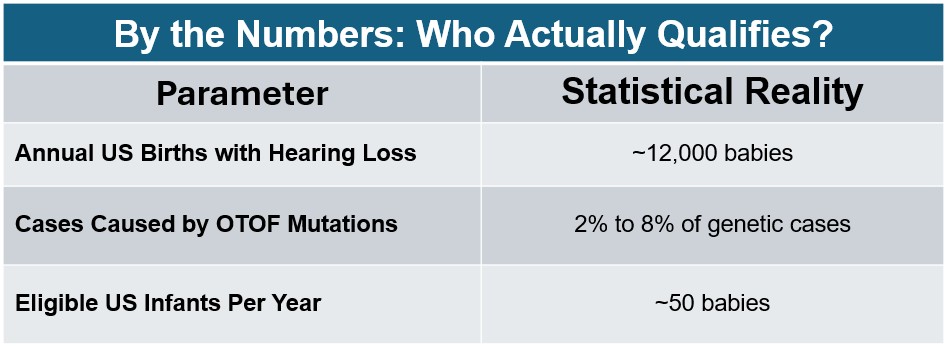
Out of 12,000 infants born with hearing loss each year in the US, only about 50 meet the precise genetic criteria for this treatment. Furthermore, candidates must have:
- Severe-to-profound, stable hearing loss present at birth (fluctuating hearing loss does not qualify).
- Intact, healthy outer hair cells.
- No prior cochlear implant in the ear receiving treatment.
Because cochlear implants have been the standard care for years, many older children and adults with OTOF mutations already have implants, rendering them ineligible for this therapy.
Unpacking the Clinical Trial Results: Real Progress vs. Media Hype
The FDA approval was backed by data from the CHORD clinical trial, which evaluated 20 participants aged 10 months to 16 years. Looking directly at the numbers helps contextualize what "success" means functionally:
-
Functional Hearing Gains: Out of 20 participants, 16 reached hearing thresholds of 70 decibels (dB) or better. While 70 dB is not normal hearing, it is a significant increase in hearing compared to a profound loss (>90 dB). It drops sound levels enough for a child to finally benefit from standard hearing aids rather than relying solely on cochlear implants. However, it should be noted that without hearing aids, one still cannot access spoken language. It is far from "normal hearing."
-
The "42% Normal Hearing" Headline: News outlets heavily reported that 42% achieved normal hearing. In reality, of the 12 participants evaluated at the 48-week mark, 5 reached normal thresholds (quiet enough to hear a whisper). Five out of 12 equals ~42%. It is an exceptional clinical outcome, but it reflects a specific subset of trial participants, not every child treated. We're talking about the results for five out of the original 20 participants.
-
Considerations for Older Children and Adults: While the FDA labeling covers adults, trial data comes almost exclusively from pediatric patients. Older individuals present unique challenges: if they already received a cochlear implant, they are ineligible. If they never had an implant, their brain missed critical early auditory development windows, making it difficult to process new sound signals effectively.
On a promising note, Regeneron announced plans to provide Otarmoni for free to eligible patients in the United States, offering relief to families navigating this complex diagnosis.
Perspective: Medical Innovation vs. Deaf Culture
The medical model views hearing loss as a deficit to be cured. But the Deaf community views deafness through a cultural and linguistic lens—a rich identity built around American Sign Language (ASL), shared values, and vibrant community norms.
There is no single "right" answer for every child. A medical breakthrough like gene therapy offers new options, but it does not replace the need for thoughtful, individualized support systems that honor both language access and a child's unique developmental pathway.
Every student with hearing loss presents a distinct set of needs, and navigating clinical options, classroom accommodations, and IEP strategies can quickly feel overwhelming.
Understanding the "what" behind medical headlines is an important first step, but implementing the "how" in a classroom or home environment requires personalized guidance.
Want to see these concepts in action? Watch the full, free video training on YouTube here:
Did Scientists Just Cure Deafness? The Truth
Get Expert Coaching & Support: Ready to fast-track your results with hands-on mentoring, proven templates, and intensive professional support?
Join the Professional Academy here
Frequently Asked Questions
Does Otarmoni mean a student will no longer need an IEP or classroom accommodations? No, gene therapy is not an instant fix for educational needs. Even if a child achieves lower decibel thresholds, they still need to learn how to process auditory information and build language skills. Classroom accommodations like FM/DM systems, acoustic modifications, and targeted speech-language goals remain essential parts of their IEP.
If a student already has a cochlear implant, can they still receive gene therapy in that same ear? No, a prior cochlear implant in the target ear automatically disqualifies a candidate for Otarmoni. The procedure requires intact outer hair cells and an un-implanted cochlea to deliver the gene vector safely. Families considering gene therapy for an un-implanted ear should consult closely with their surgical team.
How does a school team know if a student has OTOF-related hearing loss or another form of ANSD? Identifying OTOF-related hearing loss requires specific genetic testing ordered by a medical geneticist or pediatric otolaryngologist. School evaluations, such as ABR testing or audiograms, identify the functional profile of ANSD, but genetic sequencing is necessary to confirm the OTOF mutation.
Why don't standard hearing aids work well for kids with Auditory Neuropathy Spectrum Disorder? ANSD affects how sound signals are synchronized and transmitted to the brain, not just how loud sound feels. Standard hearing aids amplify all incoming audio, which often just makes a distorted, scrambled signal louder rather than clearer. This is why children with ANSD often struggle significantly in noisy classroom environments despite wearing hearing aids.
What is the financial cost of Otarmoni for families in the United States? Regeneron has stated plans to provide Otarmoni free of charge to eligible patients in the United States. However, families will still need to consider medical expenses related to surgical administration, hospital stays, and post-procedure follow-up care with their healthcare providers.
How should educators balance medical interventions with bilingual or ASL approaches? Medical interventions like gene therapy address auditory access, but language access is what drives cognitive and educational growth. Educators and parents should prioritize giving the child robust, immediate access to language—whether through spoken language, ASL, or a combination—ensuring their developmental milestones are met regardless of medical timelines.
