
Employee vs. Independent Contractor: The Math Special Education Specialists Need to Know
Jul 30, 2026
If you are a Teacher of the Deaf (TOD), Speech-Language Pathologist (SLP), Educational Interpreter, Audiologist, or any specialized service provider in special education, ask yourself this question: Do you know the exact gap between what you earn per hour and what school districts are being charged for your expertise?
Many educational specialists working through cooperatives, agencies, or traditional district contracts assume their compensation is fixed. But behind the scenes, complex financial structures dictate not only your paycheck, but also how many service minutes a school district can afford to grant a student on their Individualized Education Program (IEP).
Understanding whether you operate as a W-2 employee or a 1099 independent contractor isn't just a legal detail—it can mean thousands of dollars in your pocket, significantly more control over your workload, and fully protected services for your students.
Employee vs. Independent Contractor: Understanding the Core Differences
Before evaluating which path suits your career, you must understand how the IRS and labor laws distinguish the two models:
|
Feature |
W-2 Employee |
1099 Independent Contractor |
|
Control of Work |
Employer dictates schedule, tools, methods, and location. |
You control how, when, and where the work gets done. |
|
Tax Structure |
Employer automatically withhold income taxes and FICA. |
You pay self-employment tax (~15.3%), but gain business write-offs. |
|
Benefits |
Health insurance, paid leave, and retirement contributions may be provided. |
You fund your own health, retirement, and time off. |
|
Client Portfolio |
Single employer relationship. |
Ability to serve multiple school districts or clients simultaneously. |
Disclaimer: This article provides educational strategy, not formal legal, financial, or tax advice. Consult a qualified CPA or employment attorney for guidance specific to your state and situation.
The 4 Key Impact Areas for Educational Specialists
Deciding between employee status and running your own contracting business comes down to four core domains:
1. Control & Autonomy
Employees follow district or agency policies, schedules, and administrative documentation structures. Independent contractors retain autonomy over their clinical process, therapeutic methods, and service delivery systems.
2. Tax Write-Offs & Business Expenses
While contractors are responsible for funding their own self-employment taxes, they unlock significant tax deductions that W-2 employees cannot claim. Legitimate deductible business expenses include:
- Vehicle mileage and transportation costs between schools
- Personal computers, software, and instructional materials purchased out-of-pocket
- Professional development, conference registrations, and specialized certifications
- Home office space used for IEP documentation, virtual sessions, and planning
- Cell phone and internet services utilized for business operations
3. Benefit Funding
W-2 employees often trade higher hourly pay for district-provided health insurance and state retirement contributions. Contractors must build health insurance, paid time off, and personal retirement accounts directly into their hourly billable rate.
4. Legal Protections vs. Rate Sovereignty
Employees benefit from standard labor laws, overtime protections, and workers' compensation. Contractors trade these safety nets for rate sovereignty—the freedom to set competitive market rates and negotiate terms directly with school administrators.
The Hidden Conflict: How Third-Party Markups Threaten IEP Services
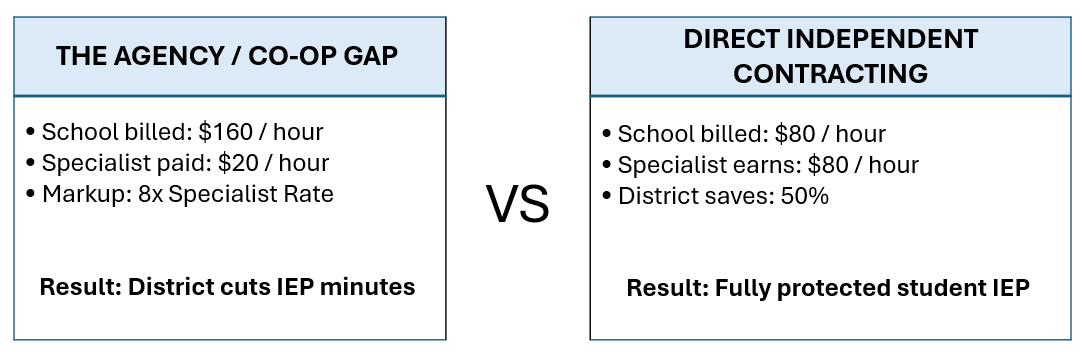
Consider how third-party staffing structures impact actual caseloads. When intermediate agencies or co-ops hire specialists at standard W-2 salaries and bill school districts up to 8 times that hourly wage, the arrangement quickly becomes financially unsustainable for the school.
When a district receives massive invoices from an agency, administrators often push back on service frequency and duration during IEP meetings. A student’s legally mandated services become vulnerable—not because of student progress, but because of an inflated middleman fee.
By transitioning from an agency W-2 worker to a direct 1099 contractor, you eliminate the middleman markup:
- The school district reduces its overall spending.
- Your take-home hourly rate increases significantly.
- The student's IEP service minutes remain fully protected.
Want to see these concepts in action?
Watch the full, free 30-minute video training on YouTube here:
Employee or Independent Contractor? A Special Ed Service Provider's Guide to Rate Calculations
How to Calculate Your True Independent Contractor Rate
If you are considering offering direct contracting services to school districts, avoid guessing your rate. Use this step-by-step financial framework:
[Annual Salary + Total Benefit Value] ÷ Annual Billable Hours = Baseline Hourly Rate Baseline Hourly Rate + Self-Employment Tax (15%) + Profit Margin = Target Contractor Rate
Step 1: Calculate Total Annual Compensation
Add your current base salary to the exact annual dollar value of your employer-provided benefits (employer health insurance contributions, retirement matching, paid leave value, and provided equipment).
Step 2: Determine Your Billable Hours
Divide that total compensation figure by your actual worked annual hours (for a standard 36-week school year at 40 hours per week, the baseline is roughly 1,440 hours). This establishes your True Hourly Baseline.
Step 3: Apply the Contractor Adjustment
Add the cost of self-employment tax (~15.3%), health insurance premiums, professional liability coverage, and operating costs. A common benchmark among seasoned specialists is to double their W-2 baseline hourly equivalent to establish a competitive, sustainable 1099 rate.
Step 4: Conduct Local Market Research
Investigate what local staffing agencies and co-ops charge districts in your region for your discipline. Position your rate below agency markup while remaining competitive with local market standards.
Action Steps to Evaluate Your Professional Status
- Calculate Your Baseline: Run the numbers on your current salary, benefits, and true hourly worth using the formula above.
- Research Agency Markups: Request public information or ask administrators what third-party providers charge for specialized services in your area.
- Consult a CPA: Meet with a tax professional familiar with self-employment in education to map out deduction potential and health insurance strategies.
- Evaluate Direct Contracting: Determine if transitioning to direct school district contracts aligns with your career goals, caseload needs, and lifestyle flexibility.
Taking the Next Step in Your Career
Understanding the business mechanics behind special education empowers you to advocate for your compensation while ensuring students receive the exact support they require.
While this guide outlines the financial framework of independent contracting, setting up contracts, managing district proposals, and navigating IEP paperwork demands actionable tools and mentoring.
Watch the Full Training: Learn the complete step-by-step breakdown by watching the free 30-minute video training on YouTube:
Employee or Independent Contractor? A Special Ed Service Provider's Guide
Join the Academy: Ready to fast-track your results with hands-on mentoring, templates, and intensive support?
Join the Professional Academy today:
Join the Professional Academy here.
(Be sure to claim your free 3-day pass via the link!)
Frequently Asked Questions
What is the difference between a W-2 employee and a 1099 independent contractor in special education?
W-2 employees receive district-provided benefits and automatic tax withholdings, but they operate under strict administrative control regarding their schedules and clinical methods. In contrast, 1099 independent contractors retain total sovereignty over their therapeutic process, work schedules, and ability to serve multiple school districts simultaneously. While contractors pay self-employment tax (~15.3%) and fund their own benefits, they unlock valuable tax write-offs and the freedom to negotiate their own billable rates.
How do third-party staffing agency markup fees impact student IEP services?
When staffing agencies charge school districts up to eight times a specialist's base salary, it creates a massive financial burden on special education budgets. These inflated middleman invoices often lead administrators to push back on therapy frequency and duration during IEP meetings. Transitioning to direct 1099 contracting eliminates agency markup, drastically lowering district expenses while ensuring student IEP minutes remain fully protected.
How can a special education specialist calculate a profitable 1099 contractor rate?
Start by adding your annual base salary to the cash value of employer-provided benefits and dividing that sum by your annual worked hours to establish your true hourly baseline. From there, factor in self-employment taxes, health insurance premiums, professional liability insurance, and operational expenses. A standard benchmark among seasoned educational contractors is to double your W-2 baseline hourly equivalent to set a competitive, sustainable rate.
What tax write-offs are available to independent educational contractors?
Unlike W-2 employees, 1099 educational contractors can deduct a wide range of operational expenses to lower their taxable income. Eligible write-offs include vehicle mileage between school sites, personal computers, therapy software, and out-of-pocket instructional materials. Independent providers can also deduct home office space used for IEP documentation, dedicated internet and phone usage, and professional development or certification fees.
How can an SLP, TOD, or specialist begin transitioning to direct school district contracting?
Begin your transition by calculating your baseline rate and researching local agency markups to understand what districts in your area currently pay for your discipline. Schedule a consultation with a tax professional experienced in educational self-employment to map out business structures and health insurance strategies. Finally, leverage specialized training resources to master district proposals, setting you up to advocate for your compensation and build a thriving practice.
