Passing is Not the Same as Preparing: Why Your Students Need the Expanded Core Curriculum (ECC)
Jan 17, 2026
“But they’re passing all their classes!”
If I had a nickel for every time I heard that from an administrator or a general education teacher, I’d have a very full piggy bank. It’s the ultimate hurdle in qualifying our students with hearing loss for services. If the grades are good, the assumption is that everything is fine.
But here is the reality we have to face: Passing is not the same as preparing.
Passing a 10th-grade history test is a great accomplishment, but it doesn't mean a student is prepared for life after graduation. It doesn't mean they can troubleshoot a hearing aid in a noisy college lecture hall or advocate for an interpreter in a job interview.
Today, let's dive into the "Why" and "How" of the Expanded Core Curriculum (ECC), the essential framework that bridges the gap between academic grades and real-world independence.
What is the ECC?
The Expanded Core Curriculum (ECC) for students who are Deaf or Hard of Hearing is a specialized framework of essential life skills. These are concepts and skills that are not typically learned through incidental overhearing.
Think about it: 80% of what children learn is through overhearing others. Our students miss that incidental language. Therefore, these skills must be explicitly taught.
The ECC covers nine critical areas: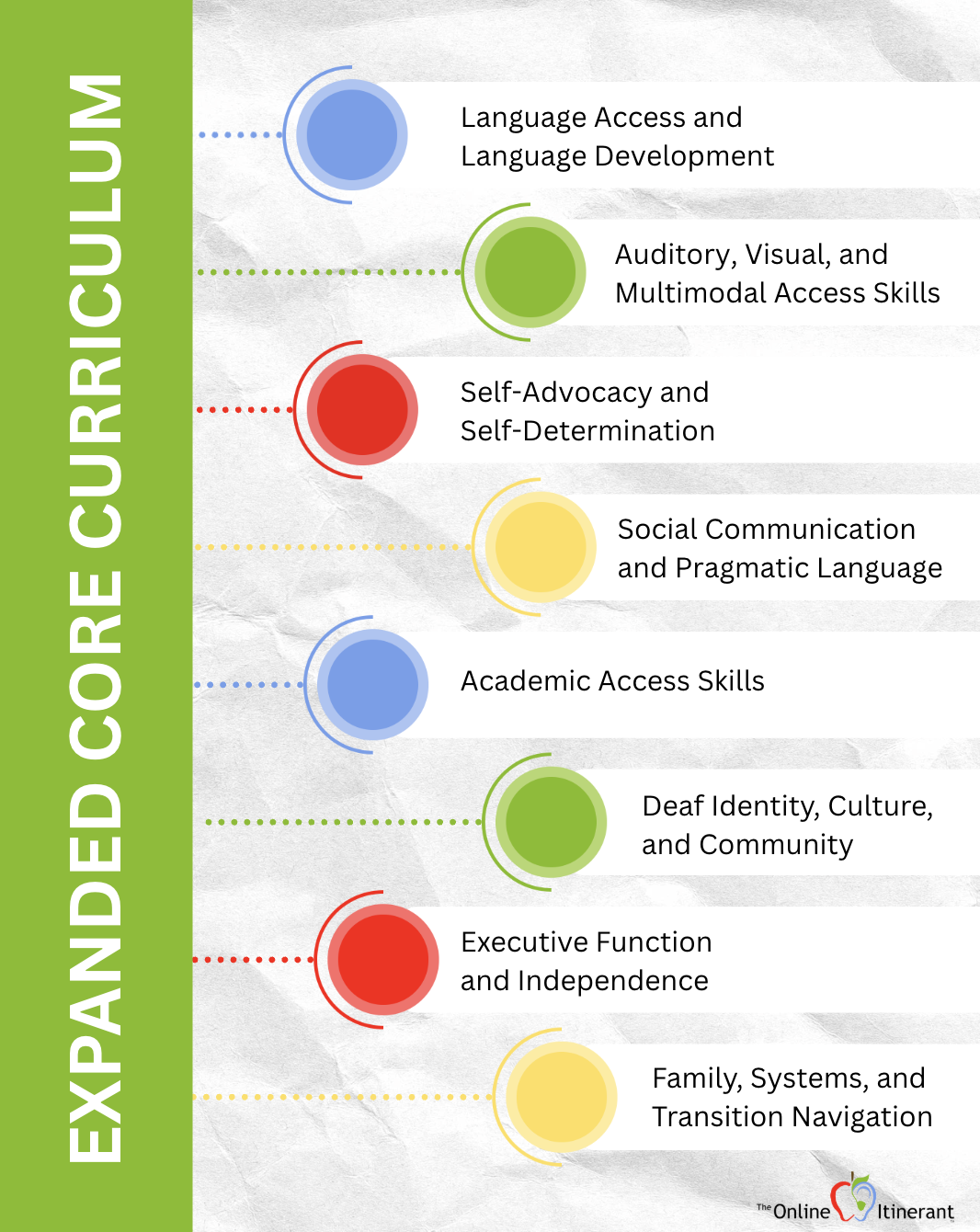
-
Audiology: Understanding the audiogram, hearing loss levels, and the anatomy of the ear.
-
Communication & Language: Developing expressive/receptive skills, whether through ASL, spoken language, or Cued Speech.
-
Self-Advocacy: Learning to explain their hearing loss to others and requesting accommodations (like captions or seating).
-
Social-Emotional: Navigating peer relationships, identitying as a DHH person, and understanding social cues.
-
Functional Skills for Educational Success: Managing "classroom survival" skills and listening fatigue.
-
Transition: Preparing for the shift to college, vocational training, or the workforce.
-
Deaf Culture & Community: Understanding the history, art, and community of Deaf people to build a positive self-image.
-
Technology: Troubleshooting hearing aids, CIs, and using Assistive Listening Devices (ALDs) independently.
-
Family Education: Empowering families to understand their child's rights, how to support language at home, and how to navigate the system.
Why is the ECC Necessary?
The statistics tell a sobering story. According to the National Deaf Center (2022), while many deaf adults start college, degree completion lags behind their hearing peers. Only about 56% of deaf students are employed after graduation.
We are often dealing with underemployment and communication barriers. If our students graduate with a 4.0 GPA but can't navigate a workplace, what was the point?
The Sensory vs. Learning Disability Gap
Most special education training focuses on learning disabilities (the largest group of SPED students). Sensory disabilities (DHH and Vision) represent the smallest group. This means many administrators don’t realize that "educational performance" isn't just about grades—it includes:
-
Social participation
-
Communication access
-
Functional performance
If a student's support system vanished tomorrow, what skills would they have left? That is the question the ECC answers.
Resources Available to You
You don't have to reinvent the wheel. Several states have pioneered incredible ECC documents that you can use as rubrics and checklists:
-
Iowa ECC: A comprehensive 51-page document with checklists for early through advanced learners.
-
Wisconsin Eligibility Criteria: Offers detailed guidelines on environmental management and legal rights.
-
Minnesota Compensatory Skills Checklist: A 20-page tool for tracking functional progress.
-
Pennsylvania's Updated Guide: A modern look at ECC with current terminology and technology and linked resources.

How the ECC Helps Parents
Parents are our greatest partners. At home, they are the primary "teachers" of incidental knowledge. When parents understand the ECC, they become powerful advocates.
Instead of just looking at a report card, a parent can ask, "Can my child explain their hearing loss to a stranger?" or "Do they know how to order for themselves at a restaurant?" Empowering parents with the ECC framework ensures that the work we do in school is reinforced at home.
TOI Tools to Support Your Work
At The Online Itinerant, we’ve built tools specifically to make the ECC manageable for busy teachers:
-
The ECC Assessment for DHH Students -
Observation Tool for Mainstream Environments -
Audit-Proof IEP Goal Bundles -
The Friend Academy
Our goal is to create independent, empowered citizens. If we only focus on academics, we are only doing half the job. If you haven't used any tools related to the Expanded Core Curriculum, what are you waiting for?
Frequently Asked Questions
Q: My administrator says I can’t use an ECC rubric from another state because it’s not "state-approved." What do I do?
A: Federal guidelines (IDEA) require a comprehensive evaluation of all areas of suspected disability, including communication and functional performance. You can also point them to Optimizing Outcomes for Students who are DHH, which is a national resource created by state directors of special education.
Q: Whose responsibility is it to teach the ECC?
A: This is the specialized instruction that qualifies a student for a Teacher of the Deaf. While we partner with audiologists and parents, the TOD is the expert who ensures these skills are explicitly taught during direct service time.
Q: What do I do if my school says the student doesn't qualify because they aren't "behind" enough on standardized tests?
A: You have to pivot the conversation back to the legal term: Adverse Impact. Standardized tests for LD students weren't designed for kids with sensory loss. Remind the team that "Educational Performance" includes social communication and incidental learning. If the student can’t hear the peer-to-peer discussions that make up 80% of classroom learning, there is an adverse impact, even if they can pass a multiple-choice test.
You mentioned "Reverse Engineering" the IEP. What does that mean?
A: I get nervous when I hear a school say a student is ready to "graduate" from services in junior high because they are doing well. I ask: "Can they navigate a college campus? Do they know how to hire an interpreter for a job interview? Do they understand their legal rights under the ADA?" We need to look at what they need for life after graduation and work backward. If they don't have those transition skills yet, they still need ECC instruction.
Q: How do I write a goal for something like self-advocacy?
A: Use the SMART formula! Instead of "Student will ask for help," try "Given a breakdown in communication, student will utilize a repair strategy (e.g., asking for repetition) in 4 out of 5 opportunities."
Q: If a student has a 4.0 GPA, can they still be eligible for DHH services under IDEA?
A: Absolutely. The law uses the phrase "adversely affects educational performance," but "educational" is not exclusive to "academic." If a student is missing 80% of incidental learning or cannot communicate their needs to peers, their educational experience is being impacted regardless of their grades. As the saying goes: Passing is not the same as preparing.
Q: Most of our SPED staff are trained in Learning Disabilities (LD). Why does that matter for my DHH students?
A: This is a huge "aha" moment for many. Statistically, the largest group in Special Education is students with Learning Disabilities, while sensory disabilities (like hearing loss) are the smallest. This means your administrators and colleagues are likely using an "LD lens" to look at your students. They are looking for standard deviations and "being behind" in reading or math. You have to be the voice that explains that a sensory disability is different—it’s an access issue, not a learning issue.
Not a member of The Professional Academy yet and thinking about joining 1000+ of your DHH teacher friends? Learn more on our website, check out a free training, and consider joining us live for a Tuesday Hack or our free 5-day challenge this month!
https://www.theonlineitinerant.com/
