The Hidden Legal Risks in DHH Education: Why "Passing Grades" Aren't Protecting Your School District
Aug 19, 2026
Beyond Good Grades: Three Landmark Court Cases Every Deaf Educator and Parent Must Know
Imagine a student sitting near the front of a busy mainstream classroom. She’s quiet, respectful, and turns in her homework on time. On paper, she’s earning straight good grades. But when the teacher turns to write on the whiteboard while continuing to lecture, the student misses the instruction entirely. During group discussions, while three peers talk over one another, she sits in silence, unable to track who is speaking.
When her parents ask for accommodations or specialized support through a teacher of the deaf, the school team responds, "Her grades are great, so she doesn't qualify."
This scenario plays out in school districts across the country every single day. Most school administrators and IEP teams don't act out of malice—they simply treat hearing loss like other special education categories. But deaf and hard-of-hearing (DHH) students are fundamentally different.
Relying solely on report cards to measure educational impact isn't just failing our students; it’s creating massive legal liability for districts. Let’s examine three real-world court cases where schools lost, the IDEA "Special Factors" most teams overlook, and the incoming legal shifts every educator and parent needs to prepare for.
Part 1: Real-World Precedents: Where School Districts Got It Wrong
When a district fails to recognize the unique language and communication barriers of a DHH student, the consequences can be devastating for the child—and costly for the school. These three landmark cases illustrate where teams go wrong.
1. Perez v. Sturgis Public Schools (Unqualified Support ≠ Communication Access)
- The Situation: Miguel Perez entered the school district in middle school with severe language deprivation. The team agreed he needed Sign Language to access the curriculum. However, unable to find a qualified Educational Interpreter, the district hired an aide who was tasked with learning sign language on the job. The aid never learned sign language beyond a basic level and generally communicated with him through made up signs, pointing, and helping him with classwork.
- The Outcome: The teachers passed Miguel in all their classes and he completed high school with top grades (even on the honor roll), but his parents discovered he couldn't read or communicate in fluent American Sign Language (ASL). After exhausting remedies under the Individuals with Disabilities Education Act (IDEA), the family sued under the Americans with Disabilities Act (ADA) for discrimination—and won the right to pursue damages.
- The Takeaway: Providing an unqualified provider or a "medial workaround" can cross the line from an inadequate IEP into illegal civil rights discrimination.
2. K.M. v. Tustin Unified School District (Academic Success Isn't Equal Access)
- The Situation: K.M., a high-achieving deaf student in a mainstream environment, requested real-time captioning (CART) to follow classroom lectures and discussions. The district denied the request, arguing that because her grades were excellent, her current setup was sufficient.
- The Outcome: The court ruled against the district. Judges noted that while K.M. grasped core academic concepts, she was systematically excluded from side conversations, peer comments, and spontaneous classroom interactions.
- The Takeaway: The ADA requires equal access, not just "enough access to pass." High-performing students are legally entitled to accommodations that give them the same level of access as their hearing peers.
3. S.P. v. Whittier City School District (The Danger of Ignoring Global Impact)
- The Situation: A preschool student with a known hearing loss was qualified for an IEP solely under the "Speech and Language" category rather than "Deaf and Hard of Hearing." Because she was doing "so well" in her preschool classroom, the only evaluated her speech and language needs and nothing else. The Teacher of the Deaf was added to the IEP as a consult to "keep her eye" on the student and help provide consultation to the staff as needed.
- The Outcome: The family sued because the school never evaluated the comprehensive, global impact of her hearing loss on her overall development. The court ruled in favor of the family, emphasizing that ignoring a known DHH disability prevents the team from providing appropriate support.
- The Takeaway: You must evaluate the full impact of hearing loss on all areas of development. Hearing loss affects language, social-emotional development, incidental learning, and environmental awareness, which has a global impact on a child.
Want to see these concepts broken down in more detail?
Watch the In-Depth Training: Want a deeper breakdown of these court cases and practical strategies for your next IEP meeting?
Watch the full, free video training on YouTube here
Part 2: The Core Misunderstanding—IDEA "Special Factors"
Why do these legal missteps keep happening? Because standard IEP procedures often overlook the Special Factors explicitly mandated by Congress under IDEA for students with hearing loss.
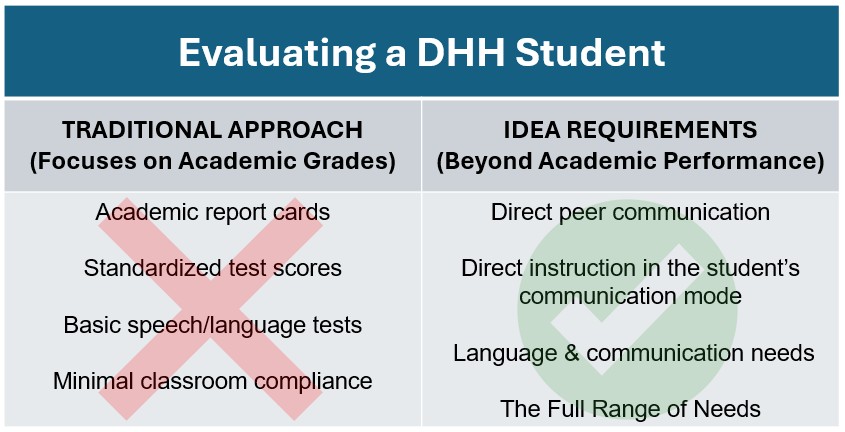
When Congress drafted IDEA, they recognized that hearing loss creates unique barriers to communication and social connection. That's why the law specifically requires IEP teams to consider:
- Direct Communication: The student's ability to communicate directly with peers and teachers in their primary language or communication mode—not just through a third-party interpreter or mediated support.
- Peer Opportunities: Access to age-appropriate peers who share the student's communication method (whether spoken language, cued speech, or ASL).
- Language Models: Exposure to adult professionals and fluent communication models.
- The Full Range of Needs: Academic performance is only one factor among many.
When an IEP team insists that a student must attend their neighborhood school under "Least Restrictive Environment" (LRE) without evaluating whether that environment offers direct peer communication, they may actually be placing the student in the most restrictive communication environment possible.
Part 3: The Next Wave of Lawsuits Waiting to Happen
Based on current educational trends and legal precedents, there are additional areas where districts are exposing themselves to future legal risk.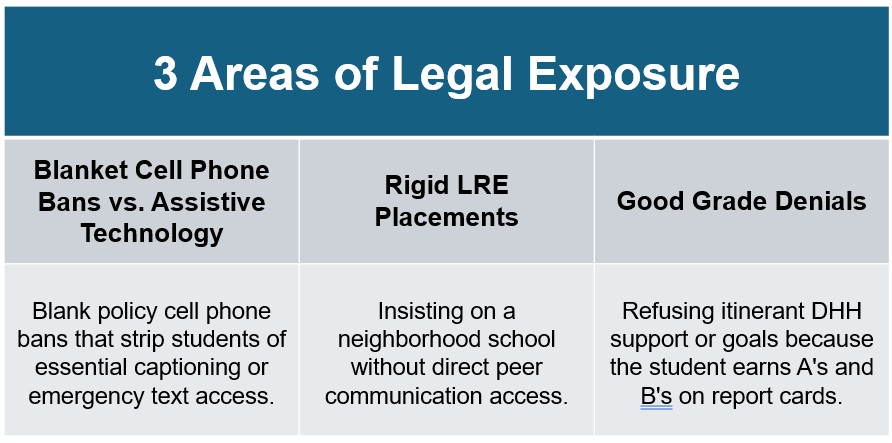
1. Blanket Cell Phone Bans vs. Assistive Technology
Many school districts are passing strict zero-tolerance policies on cell phones. However, for a hard-of-hearing student, a smartphone or personal device often serves as a vital accessibility tool—providing real-time captioning apps, direct Bluetooth streaming to hearing devices, or text-based communication in emergency situations. Denying access to these tools without providing a comparable district-funded alternative creates immediate ADA liability.
2. Misinterpreting the "Least Restrictive Environment" (LRE)
LRE does not automatically mean "the school down the street." If a child with hearig loss is placed in a mainstream classroom where no one else knows their language, they are isolated. If an IEP team fails to explore regional programs, specialized DHH classrooms, or specialized schools that offer direct peer interaction, they risk violating IDEA’s explicit Special Factors mandate.
3. Denying Itinerant DHH Support Due to High Grades
Educational impact happens everywhere: in the noisy cafeteria, on the playground, during group projects, and inside gymnasiums. When a district turns down DHH assessment, accommodations, or specialized support from a Teacher of the Deaf simply because a child has a high GPA, they are confusing academic performance with meaningful access.
Moving from Compliance to Real Impact
Protecting your school or district from legal exposure isn't about memorizing court cases—it's about shifting your mindset. True access isn't measured by a report card; it's measured by whether a child can fully participate, build social connections, and receive instruction without barrier or delay.
Whether you are an educator advocating for proper resources, an administrator evaluating compliance, or a parent fighting for your child's rights, understanding the true legal scope of DHH education is your most powerful tool.
Take the Next Step
- Watch the In-Depth Training: Want a deeper breakdown of these court cases and practical strategies for your next IEP meeting?
👉 Watch the full, free video training on YouTube here
- Get Expert Coaching & Support: Ready to fast-track your results with hands-on mentoring, proven templates, and intensive professional support?
👉 Join the Professional Academy here
